Verify existing SLD function
Vehicles expected to already have SLD capability may need functional confirmation and supporting records.
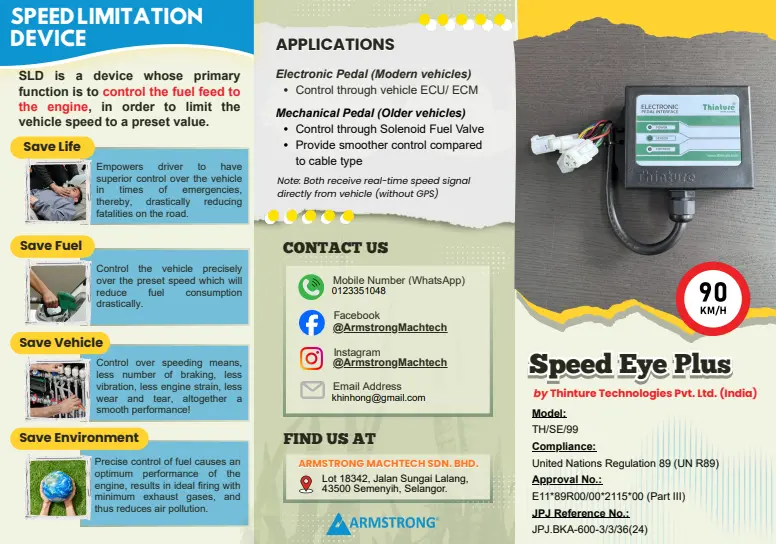
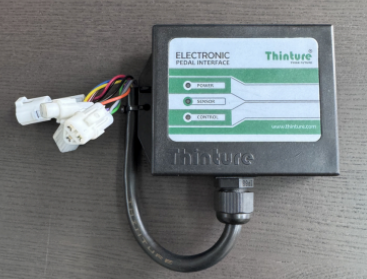
Malaysia is rolling out Speed Limitation Device requirements for selected commercial vehicles. Speed Eye Plus is a UN R89 speed limitation device positioned for retrofit conversations, using direct real-time vehicle speed signals without GPS dependency.
Malaysia’s Ministry of Transport and JPJ have introduced phased enforcement around Speed Limitation Devices for selected commercial vehicles. Depending on the vehicle, the compliance path may involve verifying an existing SLD, activating an ECU-based limiter, or installing a retrofit SLD where no system exists.
Regulatory summary based on official MOT and JPJ SLD guidance. Buyers should verify the latest applicable requirement for their specific vehicle class and registration history.
Vehicles expected to already have SLD capability may need functional confirmation and supporting records.
Some older vehicles may have dormant SLD capability in the ECU that must be activated and verified.
Vehicles without an SLD system may fall under the retrofit requirement ahead of the 1 July 2026 enforcement phase.
JPJ’s SLD guidance applies to commercial vehicles in categories M3, N2, and N3, including certain used-imported and rebuilt commercial vehicles, with specific exclusions noted in the official guideline.
Built to carry more than eight passengers, excluding the driver, with maximum weight above 5,000 kg.
Maximum weight above 3,500 kg but not exceeding 12,000 kg.
Maximum weight above 12,000 kg.
The enforcement path is phased.
For qualifying vehicles expected to already carry SLD capability, the focus is on confirming the function and obtaining the relevant SLD documentation.
For certain qualifying pre-2015 vehicles with existing ECU-based SLD function, the requirement shifts to activation and verification.
For vehicles without an existing SLD system, retrofit installation becomes the key action. This is the most commercially relevant phase for a dedicated SLD implementation.
JPJ guidance refers to documentation that confirms SLD installation and functionality.
An official verification slip confirming that the SLD installation and/or functionality has been checked according to the applicable process.
A functional report containing technical inspection details that support compliance with the SLD requirement.
JPJ retrofit guidance states that the permitted maximum SLD speed is 90 km/h and must be configured directly into the ECU or SLD device.
Speed Eye Plus is not just about limiting speed. It is positioned as a practical control system that helps improve safety, cut fuel waste, reduce mechanical stress, and support cleaner vehicle operation.
Helps drivers maintain controlled vehicle speed during everyday operation and high-risk situations.
More precise speed control helps reduce excessive fuel consumption caused by overspeeding.
Less harsh braking, less vibration, lower engine strain, and less wear and tear over time.
Fuel control contributes to better engine performance and helps reduce exhaust-related pollution.
Speed Eye Plus uses real-time vehicle speed signals directly from the vehicle itself. That makes it a stronger fit where delayed response, signal loss, and inconsistent performance are unacceptable.
Direct speed source from vehicle sensor or ECU for real-time speed limiting.
Satellite-based speed reference can introduce delay, dependency, and inconsistency in certain environments.
The device reads vehicle speed in real time, detects when the preset threshold is reached, and controls fuel feed to keep speed within the intended limit.
Receives real-time speed signal directly from the vehicle sensor or ECU/ECM.
Continuously checks speed against the configured limit value.
Regulates fuel feed to the engine as the speed limit is approached or reached.
Helps prevent overspeeding with smoother, more reliable control than delay-prone systems.
One path addresses modern electronic pedal vehicles. The other addresses older mechanical pedal vehicles using solenoid fuel valve control.
Designed for vehicles where speed control is integrated through the vehicle ECU or ECM.
Uses solenoid fuel valve control for older vehicles and is positioned as smoother and stronger than cable type alternatives.
Speed Eye Plus
Model: TH/SE/99
United Nations Regulation 89 (UN R89)
Approval No.: E11*89R00/00*2115*00 (Part III)
JPJ.BKA-600-3/3/36(24)
JPJ guidance centres on commercial vehicle categories M3, N2 and N3, with additional relevance for certain rebuilt and used imported commercial vehicles.
The retrofit phase is set for 1 July 2026 for vehicles that fall under the relevant requirement and do not already have an SLD system.
Depending on the phase and vehicle profile, the requirement may be to activate and verify the existing limiter rather than install new retrofit hardware.
JPJ retrofit guidance states a permitted maximum configured speed of 90 km/h.
The guidance refers to a Slip Pengesahan and a Laporan Kefungsian SLD as the key proof documents supporting the applicable compliance process.
No. It is positioned as sensor-based, using real-time speed signals directly from the vehicle rather than depending on GPS.
Talk to the team about Speed Eye Plus, vehicle suitability, and the next compliance conversation to have.
Distributor
Armstrong Machtech Sdn. Bhd.
Address
Lot 18342, Jalan Sungai Lalang, 43500 Semenyih, Selangor
WhatsApp / Mobile
Share your vehicle type, fleet size, or retrofit question and we will follow up.